
Why Big Projects Fail
Large projects that get delayed by many years and waste copious amounts of money rarely fail during execution. They fail even before the foundation stone is laid. How? Let’s find out.

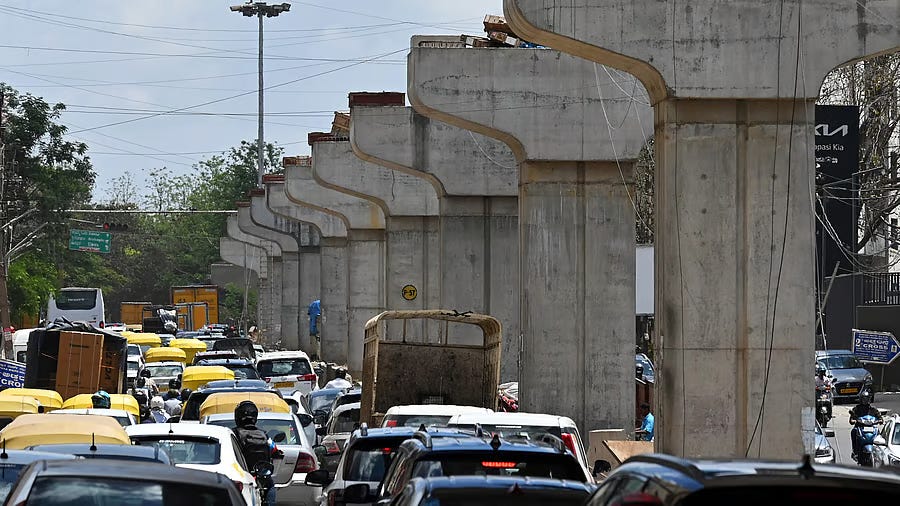
If you’ve spent any meaningful time in Bangalore, you know the Ejipura flyover. The flyover that refuses to become one. For years, it has loomed over one of the city’s most congested stretches as a half-built monument. It was meant to eliminate the congestion. Now it’s the very reason the Ejipura-Koramangala corridor is one of Bangalore’s most dreaded daily commutes.
To put things in perspective, the Burj Khalifa — the tallest building on earth — was constructed in six years. The Empire State Building took just 410 days to finish, back in 1930-31. This flyover, 2.38 kilometres long, has been under construction for eight years. Recently, yet another deadline was announced — July 2026. Bangaloreans have heard this before.
The flyover was conceived in the early 2010s. It was formally tendered in 2017, with a two-year completion window. Two years passed, and another two, with little progress. In 2023, BBMP floated its fourth tender. As of early 2026, only about 60-65% of the 2.38 km structure has been completed.
This project has witnessed three governments, four contractors, and one pandemic across eight years. Its completion deadline has been reset so many times that the announcement of a new one feels like tradition.
If you think this is a typical India problem, you’re not wrong, but hold that thought. Let me share a more spectacular example.
In 2008, California voters approved a $33 billion bond measure to build a high speed rail line connecting San Francisco to Los Angeles — a journey the train would complete in under three hours. It was a transformative vision. It was also, as it turned out, a plan assembled more around political momentum than engineering reality.
It took another seven years for the construction to begin in 2015, that too not in San Francisco or Los Angeles, but in California’s Central Valley — in the agricultural farmland between Fresno and Bakersfield. The reasoning was, start where land was cheaper and opposition thinner, build momentum, and extend north and south from there. Let’s just say it didn’t work out as planned.
By 2019, the California Governor buried the original dream. The 800-mile San Francisco to Los Angeles line was no longer viable, he said. The revised ambition: a 171-mile segment between Merced and Bakersfield — two cities that were never the point of the project. The bullet train that was supposed to connect California’s two great cities had been reduced to a line between two that most Californians would struggle to place on a map.
To top it all, this segment alone is now projected to cost $35-$38 billion, roughly what the entire SF to LA line was originally budgeted to cost. The full Phase 1, if it is ever built, is now projected to cost over $126 billion. As Ezra Klein and Derek Thompson noted in their book Abundance, in the time California has spent failing to build 500 miles of high speed rail, China has built more than 23,000.
The two projects — a 2.38 km flyover in Bangalore, and an 800-mile rail network in California — are different in scale, resources, and in every conceivable context, but identical in the pattern of their failure.
So why does this keep happening? Why do projects with so much riding on them collapse so consistently into delay and dysfunction?
You may think it’s bad execution. That does play its part, but mostly, these plans fail much before execution begins.
There is a deeply ingrained belief in politics, and equally in business, that action equals progress. That movement is the same as momentum. When a government announces a new project, breaks ground, clicks a photograph at a ribbon cutting, it signals that something is being done. For a politician facing an election or an administrator trying to demonstrate performance, this logic is almost irresistible. The groundbreaking ceremony is visible on the evening news. The planning meeting is not.
And so we rush to make announcements. The ribbon gets cut before the route is fully cleared. The contractor is appointed before the land is acquired. The budget is published before anyone has seriously reckoned with what the project will actually encounter. Everyone involved knows, at some level, that the plan is incomplete. But stopping to finish it feels like delay. And delay, in many scenarios, looks like failure.
The problem is that for projects of this scale, the planning phase is the only time when problems are still cheap to solve. On paper, a land dispute is a conversation. In the middle of active construction, it is a court case that halts work for two years. The Ejipura flyover’s construction was frozen in part because nobody had resolved the land near St. John’s Medical College before the first shovel went in. California began grading farmland before acquiring all of it. A state auditor flagged this in 2018. By then, billions had already been committed and the project’s fate was largely sealed.
Incomplete planning is one of the surest ways to delay or stall a project. And unlike a business pivot or a scrapped internal initiative, a half-built flyover or a half-graded rail corridor or a half-dug tunnel cannot simply be undone. You are committed, publicly and irreversibly, to finishing something whose foundations were never sound to begin with.
This is what makes poor planning different from most other kinds of mistakes. Most mistakes can be corrected. These ones compound.
The antidote, as the researcher Bent Flyvbjerg argues in his book How Big Things Get Done, is captured in a deceptively simple principle: Think Slow, Act Fast.
Not slow in the sense of bureaucratic paralysis. Slow in the sense of deliberate, rigorous, exhaustive preparation — the kind that leaves almost nothing to chance before the first resource is committed. And then fast: once that groundwork is laid, execute with full force and without hesitation.
The distinction sounds obvious, but in practice, it is routinely ignored.
Flyvbjerg’s research across thousands of megaprojects shows that the biggest single predictor of a project’s failure is not execution, but what he calls the “planning fallacy”: the systematic tendency to underestimate cost, time, and complexity at the outset because project leaders are seduced by the vision and rush past the due diligence. They look at their project as unique, exceptional, unlike anything that has come before, and in doing so they ignore the statistical reality of what actually happens to similar projects. Data shows that across infrastructure projects globally, the majority go over budget, most are delayed, and a significant number never deliver the outcomes they promised. These are not exceptions. They are the rule for projects that begin before the planning is complete.
The remedy is to front-load the intelligence. Put the best available minds on the planning process — engineers, domain experts, experienced consultants who have seen what goes wrong — before a single contract is signed. This is precisely why experienced specialists and advisors earn their place in high-stakes projects.
This applies equally to the world of startups and product companies. The culture of “move fast and break things” became ingrained largely because startups themselves were earlier synonymous with software products. You could roll out a feature, test it, take feedback, and then pivot or double down. Mistakes were reversible and could be rectified. But people have forgotten that not everything can be broken and fixed in the next sprint.
You cannot roll out an electric scooter to thousands of customers and discover through numerous fire incidents that the battery management system was undertested. You cannot launch a food product and learn about its safety failures from the people who ate it. The “fail fast” philosophy, when applied to irreversible, physical, or safety-critical products, is simply negligence with a philosophy attached to it.
The root cause in all such cases is the same. Someone decided that the cost of not starting immediately was higher than the cost of starting without being ready. They thought fast. And since then, they have been acting slow, or not at all. Thinking slow, properly and thoroughly, is the only thing that reliably earns you the right to act fast.
The bigger the project, the more irreversible its early decisions, the more catastrophically a poor plan compounds over time — and the more indispensable the patient, unglamorous work of thinking it all the way through before the first move is made.
When you see a monumental project delivered well and on time, execution will get the credit, but know that slow, thoughtful, deliberate planning enabled it. And if a large project is delayed materially, it’s probably because someone was too excited to demonstrate action and forgot to assess the realities when they should have, and could have.
Question for you
In your experience, has planning ever actually saved an important project from collapsing? Or has there been a case where you didn’t achieve what you could and realized, in hindsight, that better planning could have helped?
What we’re reading
How Big Things Get Done by Brent Flyvbjerg and Dan Gardener. This entire idea of ‘Think Slow, Act Fast’ is a chapter by the same title in the book. One of the most interesting books I’ve read in recent times.
Until next time.
Best,
It's also a lot to do with the tenders.
Construction tenders are super-competitive. Combine this with the low frequency of them, getting big tenders is always an existential question for the companies applying for the tender.
A lot of tenders in the country are decided basis on how low your quote was relative to what the government has estimated.
To win, companies always quote lower numbers to get their foot in, and then they end up pushing for more budgets, since what they quoted initially was unrealistic.
There was a simulation that Dr. Georgio Locatelli mentioned once, in how they simulated a tender, being applied to by many bots, and see who wins.. The bots eventually started quoting cost and time much below what was possible, just to win the quote.
Good read, subscribed!
Im farther along the spectrum than I thought; stuck at the planning phase forever. Executive dysfunction and grave procrastination may have preemptively saved me from failure. Am I glad about it? Half of me is after reading this. :)
Lovely read, though! Insightful. Keen to explore how Big Things Get Done!