
Permission, Not Possession
Buying decoupled from owning, owning decoupled from using

I spent over ten years in Bangalore as an employed bachelor, which meant moving apartments more often than I would have liked. However civil my friends and I were, being a bachelor was a cardinal sin in the eyes of most apartment owners, and we rarely stuck around for than a year at one place.
For the first couple of years, I carried an ever-growing collection of books with me from one place to the next. Reading had been a passion, and I was proud of my collection. By the third year, I needed help from friends to move all the books into my new place. That was when I seriously considered a Kindle.
A single notebook-sized device that held every book I could ever want to read. The prospect was difficult to argue with. In principle, a reader’s utopia. But of course it was not the same. Walking into a bookshop and finding a book you were not looking for. The smell of the pages. The corner you folded down so you could come back to it later. All of that is part of an experience that a technologically brilliant, good-for-your-eyes Kindle cannot deliver. I gave in anyway. Over the next year I fought myself at every turn and slowly became used to reading on a screen.
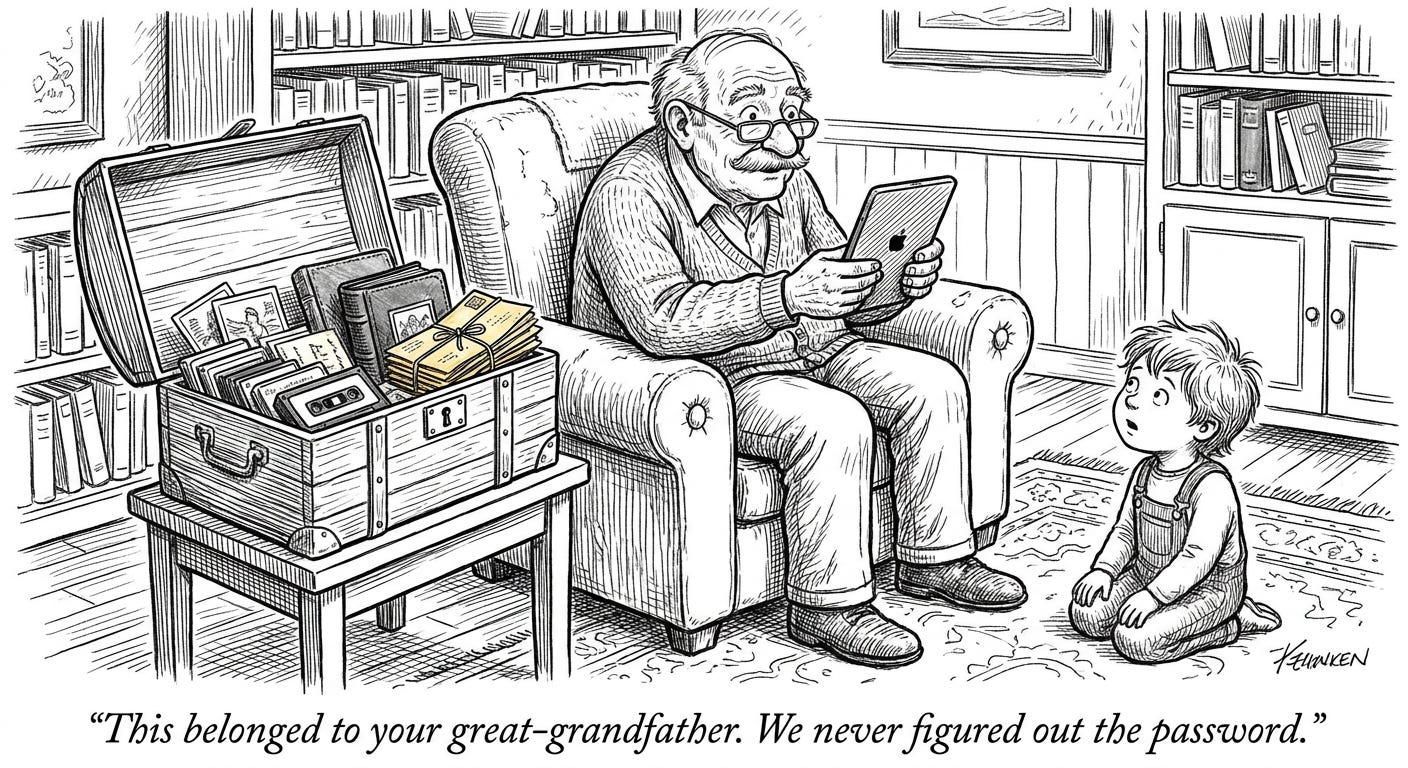
A couple of years ago, my parents had to move cities. As I helped them pack, I kept finding things that were staples of my childhood memory. A collection of tattered books my father has held on to for decades. A set of music cassettes we no longer have anything to play on. Old photographs. A handful of small trinkets that had belonged to my grandparents.
My father pulled out a yellowed scrap of paper, carefully wrapped in plastic. An autograph of Pandit Ravi Shankar. “You’ll inherit this when I’m gone,” he said, casually. He slipped the paper back between two pages of Anandamath and waved the book at me. “This one too.”
Today my Kindle lies on my bedside. It contains some 130 titles. None of them can be passed on. The license is tied to my Amazon account, which, depending on how Amazon’s bereavement process goes, will either be closed or quietly maintained under credentials handed off to someone else.
My Spotify “Liked Songs” will disappear the moment the account is de-linked.
What do I actually own?
It is a small, specific question I find myself pondering while watching my son find new ways to hurt himself at the playground.
The autograph inside Anandamath is doing five things at once.
We tend to treat any purchase as a single act, but it was always five.
It transferred a right — my father obtained the paper, the encounter was his, no one else could claim it.
It enabled use — the autograph could be looked at, shown to a guest, pulled out and explained; the book itself could be read, marked, returned to.
It had permanence — it has survived multiple house moves, multiple decades, multiple eras of Indian music.
It allowed inheritance — my father has already decided what becomes of it, and the transfer needs nothing more than the gesture of placing the book in my hands.
And it signalled intention.
The whole arc, from being in the hall where Pandit Ravi Shankar happened to be playing, to choosing which book the paper should live inside, is a statement about the kind of life my father has been trying to live.
For most of human history the five-part bundle was so seamless we never noticed it was five. We bought coats. We owned them. We wore them. They outlived their first owners. The coats were also, underneath, expressions of taste.
Two of those five are now optional. Sometimes more.
Whose right is it anyway?
The fine print of every “buy” button we have clicked says the same thing: this is a license, not a sale. The seller reserves the right to revoke it. Most of the time we do not notice, because most of the time the seller does not.
But sometimes they do. On December 31, 2023, Sony deleted 1,300 seasons of Discovery shows from PlayStation users’ libraries — full series people had paid for, gone overnight, no refund. In July 2009, Amazon deleted copies of 1984 from Kindle devices over a publisher dispute. An irony Orwell would appreciate, I am sure. In 2024, Ubisoft’s director of subscriptions said that players would need to “become comfortable with not owning their games.” The quiet part being said aloud.
BMW tried to push the same idea into hardware. In 2022, they began charging eighteen dollars a month for heated seats. The coil already installed in the car, paid for, sitting there, waiting for a subscription. The backlash forced them to retreat. The lesson they took was not to back away from subscriptions, but to keep them invisible. ConnectedDrive now charges for adaptive cruise, parking assistance, even “Apple CarPlay preparation.” Tesla charges monthly for Full Self-Driving and recently removed the one-time-purchase option entirely. Hyundai’s BlueLink, Tata’s iRA, and Mahindra’s AdrenoX all renew on subscriptions after the complimentary period.
The 130 titles on my Kindle cannot legally be transferred to anyone. The library dissolves when the account does. A wall of physical books still flows through generations the way an inheritance is supposed to. The Kindle, holding ten times more, does not.
The pattern is consistent. Right, permanence, inheritance — the three slowest, most boring functions of buying are being quietly unbundled out of the transaction. What is left is access for as long as the seller decides.
We chose it. We traded the weight of permanence for the frictionless ease of access. We outsourced the maintenance, the storage, and the physical footprint of ownership to the cloud. But in doing so, we handed over the keys.
The intention is the act
There is another perspective at play.
My Kindle holds 130 titles. I have, generously counting, read perhaps 70 of them. The rest sit in the library because a sample drew me in, or someone recommended a book, or a review made me feel like the kind of person who should be reading it.
There is a Japanese word for this: tsundoku. The habit of acquiring books and letting them pile up unread. The pattern is everywhere. WordsRated found that 28.76% of people who start a book never finish it. Kobo, which can see exactly when readers stop tapping their screens, reports that most bestsellers do not get finished by most buyers. Gym memberships peak in January and the actual visits collapse by March.
What is interesting about most of these is when the value arrives. Not at the moment of use. At the moment of purchase. The buying is the consumption. We bought a book about discipline. The buying was the discipline. The reading is optional.
We have quietly invented a category of object whose function is to signal intention and the audience for the signal is internal. We are not buying Kahneman so visitors will think we have read Kahneman. We are buying him so we — the person on the metro, the person on the couch, the person we might become — can think of ourselves as someone who reads Kahneman.
Put a few ordinary objects against the five-part test and the shape becomes visible.
A paperback bought twenty years ago and read three times passes on all five counts. Owned. Used. Permanent. Inheritable. Intentional. The full bundle.
An unread hardcover on a shelf passes on four counts. Owned. Permanent. Inheritable. Intentional. But not used. The future self never arrived. Still, the book remains, and someone else could pick it up. The hardcover is patient. It does not need a password.
A Kindle library reverses it. Used, mostly. But not owned, not really permanent, not inheritable. The signal of intention was there but the library itself does not survive its buyer. A car with subscription features. Used, but parts of it evaporate at title transfer. A Spotify “Liked Songs” list. Used, but vanishes at account closure. A streaming plan. Used, lapses, renews, but never accumulates into anything inheritable.
The shape becomes visible only when we tile them next to each other. The only one that the modern transaction always delivers is the signal of intention. The click, the swipe, the moment a card is read. That part still works.
We are running an economy where the signal is the entire product. The thing that follows the signal is increasingly negotiable. Sometimes it does not arrive. Sometimes it arrives and disappears. Sometimes it arrives and never gets used. What is reliable is the brief flash of becoming, for one moment, the kind of person who bought this.
What passes on
There is a word we use in India — vasiyat — for what is left behind. A house. A piece of farmland. Jewellery. A grandmother’s recipes. An autograph wrapped in plastic, tucked into a particular novel for safekeeping.
The objects of vasiyat were not always expensive. They were almost never the most valuable things in the household. What gave them their weight was that they had been with someone for a long time. They had soaked up a life. When they moved into the next generation, the life moved with them.
Of course, this romanticizes the physical. Physical objects can be a tremendous burden—they burn, they flood, they take up space, and they demand upkeep. We shed that burden when we moved to the cloud. But we also shed the capacity for an object to carry meaning across generations.
The new economy is not really capable of producing objects like this. A Kindle does not soak up a life. A Spotify account does not. A subscription does not. A licensed digital file does not. What survives a person in 2026 is increasingly the receipts. A long string of email confirmations from companies that may or may not still exist when someone tries to retrieve them.
The autograph in Anandamath will go to me one day. I do not know what I will pass on to my son.
A question for you.
What would you do differently if you knew, walking out of every store, that the receipt was the part you’d keep?
Subscriber Spotlight
Nandini Chandra shared thoughts on Utkarsh’s piece, Where Are You From?
“Made me pause, made me think and after a lot of thought, I have come to the realization that - 1) the idea of home is deeply personal ergo subjective and 2) home is not a place to survive but is a place to live (given that one understands the difference between surviving and living).
Not sure if I was able to articulate my very intense and emotional response after reading this piece but glad that I came across it. Thank you for sharing. :)”
What we are reading at Wyzr
Who Owns the Future? by Jaron Lanier. A very early work on concentration of power and money in digital networks. He saw most of our current reality coming a decade ago.
Until next time.
Best,
This made me rethink what ownership really means in the digital age.
We traded permanence for convenience so gradually that we barely noticed the cost.
The idea that “the receipt is the only thing we keep” is both unsettling and painfully true.
Your father’s autograph inside Anandamath carries more legacy than a thousand cloud files ever could.
A deeply thoughtful piece on memory, inheritance, and the difference between access and belonging.
Best piece I read in a long time